K-Factor Calculator
One way to assess whether a fish is in poor, good, or excellent condition is by calculating the fish's K-factor. This typically involves a visual assessment where shape, length, weight, and overall appearance are evaluated and compared with previous catches.
It's not uncommon to see on Facebook or similar fishing groups, "Yesterday, I caught this really fat trout. K-factor of 1.8." But how do you estimate the K-factor when you know the length and weight? Use the calculator and find out.
Result Ranges for Trout:
- Around 0.8: Thin fish and poor condition
- Around 1: Normal condition
- Over 1.2: Very fine condition
- Over 1.5: Absolutely exceptional
To perform a measurement, you must find the fish's correct weight and length. A kitchen scale can be a useful tool, as it provides measurements in whole grams.
To measure length, lay the fish on a flat surface. Length is measured from the tip of the snout to the back edge of the tail fin. Enter the values in the calculator to find the K-factor.
This is what the formula for calculating the K-factor looks like:
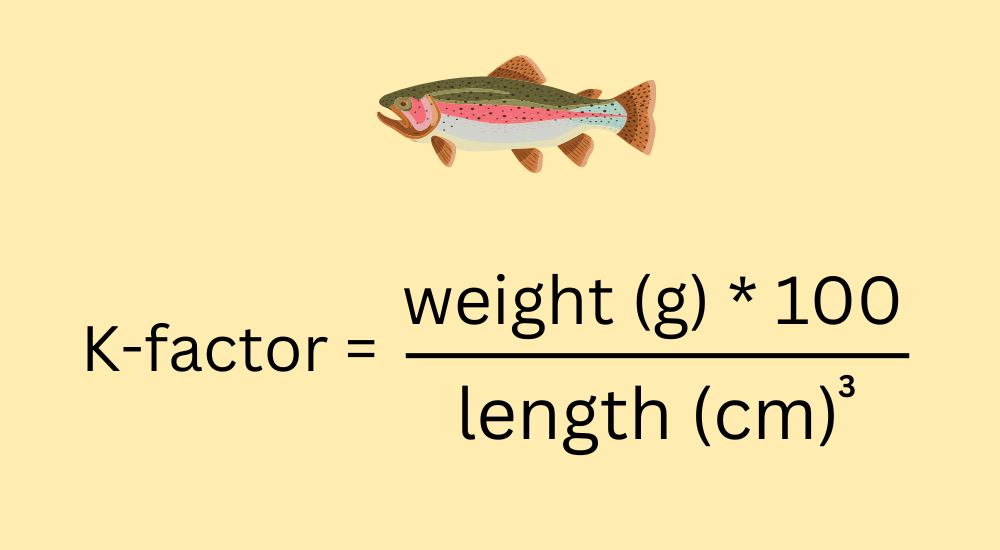
The K-factor can be influenced by factors including gender, season, diet, amount of food consumed, fat reserves, muscle development, and the age of the fish. It is often observed that the K-factor of females drops drastically after laying eggs.
The calculation is most commonly used for trout and salmon, but it can also be applied to other fish species. Fish species with different genetic shapes will naturally have different classifications when it comes to condition.
K-Factor Table for Trout (30-80 cm)
The table displays length in the left column and the corresponding weight in grams for different K-Factor classes at 0.8, 1, and 1.2.
| Length (cm) | 0.8 K-Factor | 1 K-Factor | 1.2 K-Factor |
|---|
The Importance of Fish Condition
We use the K-factor to provide an estimate of the fish's health status and whether it is suitable as a food fish. Fish that have recently spawned or are otherwise in thin and poor condition (spent) are not good for consumption and should be gently released back.
A fish with a low K-factor may also indicate that the food availability in the water is not optimal.
Recommended: Human Years to Dog Age Calculator