Use this calculator to estimate how much you can lift in your 1RM (one-repetition maximum) bench press when you know the weight and number of repetitions.
The calculation will provide an estimate, not an exact answer, as various factors can influence the result. Nonetheless, it can give you an idea of your maximum strength without pushing yourself to the limit, reducing the risk of injury.
Bench Press Calculator
How the Bench Press Calculator Works:
The calculation is based on the Brzycki formula, a method used to estimate how much you can lift with a single repetition in the bench press when you know the executed weight and number of repetitions.
There will be individual variations in the actual result due to different physical factors and techniques.
Formula for Calculation:
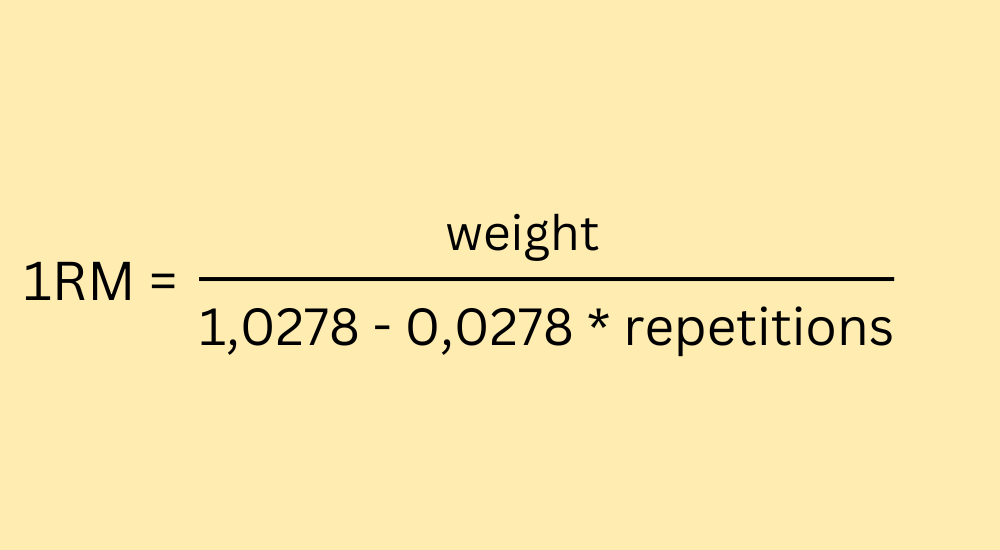
This is what the numbers mean:
1RM indicates the maximum weight for one repetition.
The weight indicates the number of kilograms lifted.
The number of repetitions simply refers to the number of times you lift the specified weight.
Example Calculation: If you have 60 kg in your working set and 8 repetitions, the calculation of 1RM max bench press would look like this:
The numerator (the number above the division line) is naturally 60.
The denominator is calculated as follows:
1.0278 - 0.0278x8 = 1.0278 - 0.2224 = 0.8054
Finally, the calculation becomes:
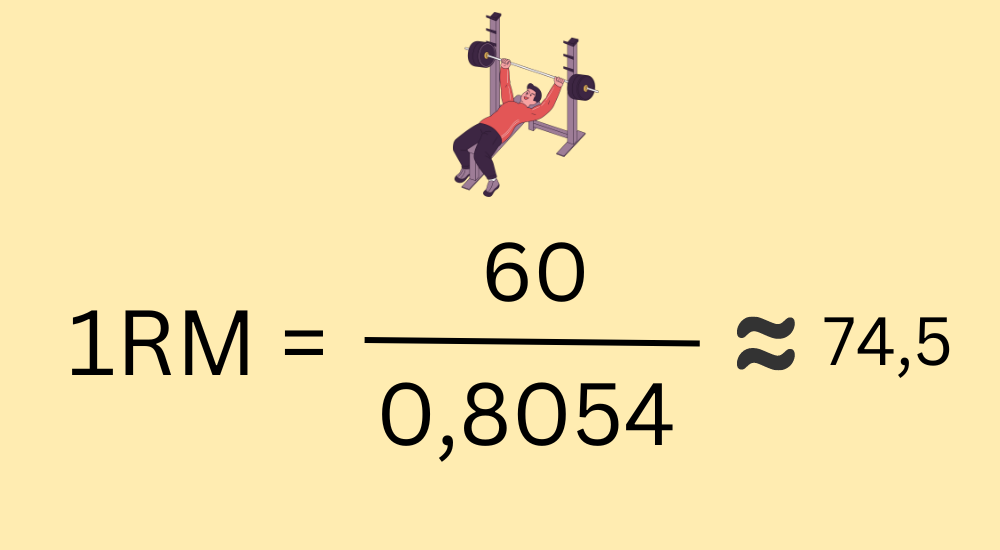
Based on the Brzycki formula, the person would then have a 1RM max bench press of about 74.5 kg.
What Muscles Do You Use When Bench Pressing?
When you bench press, you primarily use the chest, triceps, and front part of the shoulders. The chest muscles mainly handle the pressing movement by pushing the weight up from the chest. At the same time, the triceps are used to press the bar in the final part of the movement.
Secondarily, both biceps, forearms, and core muscles are used. The bench press is therefore an exercise that activates many muscles.
What Variations of Bench Press Exist?
- Flat bench press: Standard bench on a flat bench.
- Incline bench press: Bench angled upwards, performed with a bar.
- Decline bench press: Bench performed on a bench that has a negative angle.
- Dumbbell bench press: Performed with dumbbells.
- Wide grip bench press: Normally performed with a grip wider than shoulder width.
- Narrow grip bench press: Narrow grip to activate the triceps more.
- Reverse grip bench press: Performed by having the palms facing towards the face.
- Floor press: Performed by lying on your back on the floor.
What is the World Record in Bench Press?
As of now, Julius Maddox holds the world record in bench press with his lift of 355 kg in 2021 at the Ghost Strong Hybrid Showdown. The lift was performed without a belt, but with wrist supports.
Related calculator: BMI calculator